
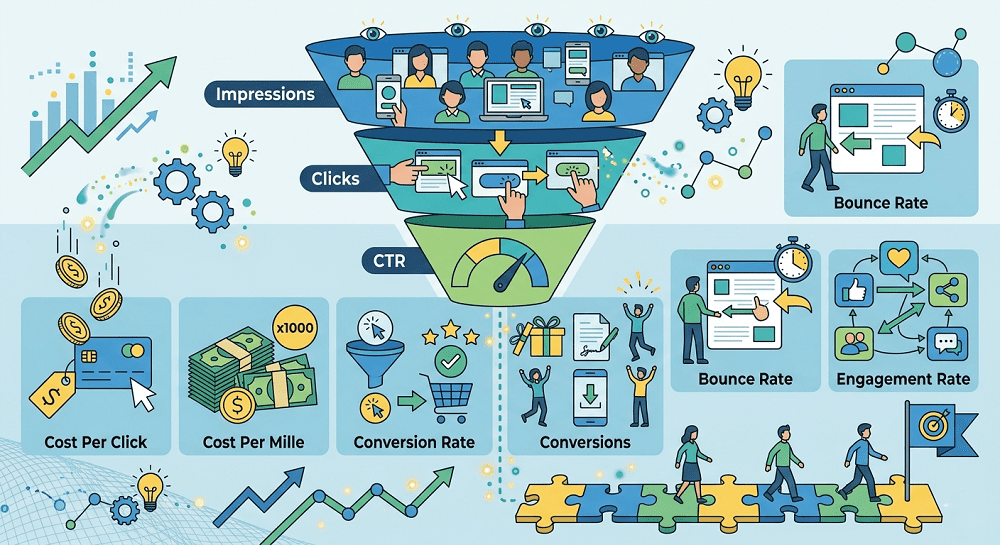
In today’s digital world, success isn’t just about running ads or publishing content—it’s about understanding how people interact with it. Whether you’re using tools like Google Analytics or running paid campaigns, metrics like Impressions, Clicks, and CTR (Click-Through Rate) are essential to measure performance and make smarter decisions.
This guide breaks down these core analytics metrics in a simple, practical way so you can confidently analyze and improve your campaigns.
What Are Impressions?
Impressions refer to the number of times your content, ad, or link is displayed on a user’s screen.
Think of impressions as visibility.
- If your ad appears 5,000 times → that’s 5,000 impressions
- The same user seeing your ad multiple times counts multiple times
👉 Why it matters:
Impressions tell you how widely your content is being seen—but they don’t guarantee engagement.
What Are Clicks?
Clicks measure how many times users actually interact with your content by clicking on it.
- 5,000 impressions + 200 clicks → means 200 people took action
👉 Why it matters:
Clicks indicate interest. If people click, your content is doing something right.
What Is CTR (Click-Through Rate)?
CTR is one of the most important performance metrics. It shows the percentage of people who clicked after seeing your content.
Formula:
CTR = (Clicks ÷ Impressions) × 100
Example:
- 200 clicks ÷ 5,000 impressions = 4% CTR
👉 Why it matters:
CTR tells you how effective your ad, headline, or creative is.
- High CTR → Your content is relevant and engaging
- Low CTR → Your message may not be resonating
Supporting Metrics You Should Know
1. Cost Per Click (CPC)
This tells you how much you pay for each click (important in paid ads).
Formula:
CPC = Total Cost ÷ Clicks
👉 Helps you control spending and evaluate efficiency.
2. Cost Per Mille (CPM)
This is the cost for every 1,000 impressions.
Formula:
CPM = (Cost ÷ Impressions) × 1,000
👉 Useful for measuring brand awareness campaigns.
3. Conversion Rate
This measures how many users take a desired action after clicking (buying, signing up, etc.).
Formula:
Conversion Rate = (Conversions ÷ Clicks) × 100
👉 This is where real business value happens.
4. Conversions
A conversion is any completed goal:
- Purchase
- Form submission
- App download
👉 Not all clicks lead to conversions—that’s why tracking this matters.
5. Bounce Rate
This shows the percentage of visitors who leave without interacting further.
👉 A high bounce rate may indicate:
- Poor landing page design
- Slow loading speed
- Misleading ad content
6. Engagement Rate
Common in social media, this measures interactions like:
- Likes
- Shares
- Comments
👉 It reflects how compelling your content is.
How These Metrics Work Together
These metrics form a marketing funnel:
- Impressions → People see your content
- Clicks → Some users show interest
- CTR → Measures effectiveness
- Conversions → Business results
Real-World Example
Let’s say you run a campaign:
- Impressions: 10,000
- Clicks: 300
- CTR: 3%
- Conversions: 30
What this means:
- 3% of viewers clicked
- 10% of those clicks turned into customers
👉 That’s a solid performance depending on your industry.
How to Interpret Your Data
Understanding the relationship between these metrics is key:
- High Impressions + Low CTR
→ Your content isn’t engaging enough - Low Impressions + High CTR
→ Great content, but limited reach - High Clicks + Low Conversions
→ Problem with your landing page or offer - High CTR + High Conversions
→ You’ve found a winning strategy
Final Thoughts
Metrics like CTR, Clicks, and Impressions are more than just numbers—they tell a story about your audience and your content. By understanding and analyzing them together, you can:
- Improve ad performance
- Optimize marketing budgets
- Increase conversions
- Make data-driven decisions
The key is not just tracking these metrics—but acting on them.